Peptide drugs, combining high biological activity with exceptional selectivity, have emerged as a profoundly transformative new class of therapeutics following small-molecule chemical drugs and antibody drugs. They demonstrate tremendous clinical translational potential and industrial value in metabolic diseases, autoimmune disorders, cardiovascular diseases, and beyond. The development of oral peptide products carries far-reaching clinical significance and societal value: it holds the promise of replacing conventional parenteral administration, substantially enhancing patient adherence and quality of life, reducing the long-term burden on healthcare systems, and greatly expanding market accessibility for peptide therapeutics. However, oral peptide administration faces multiple biological barriers, including gastric acid and gastrointestinal enzymatic degradation, poor intestinal epithelial permeability, and hepatic metabolism, thus significantly constraining scientific research and industrial development in this field. To date, only a handful of oral peptide drugs have successfully reached the global market.
Our laboratory breaks away from the current high-cost, low-efficiency paradigm of oral peptide formulation development that relies on "trial-and-error" approaches. We are dedicated to constructing a scientific theoretical framework grounded in the "first principles" of molecular–material interactions, deeply integrated with systematic understanding of gastrointestinal (GI) biology and physiology, striving to advance from empirical exploration toward rational design.
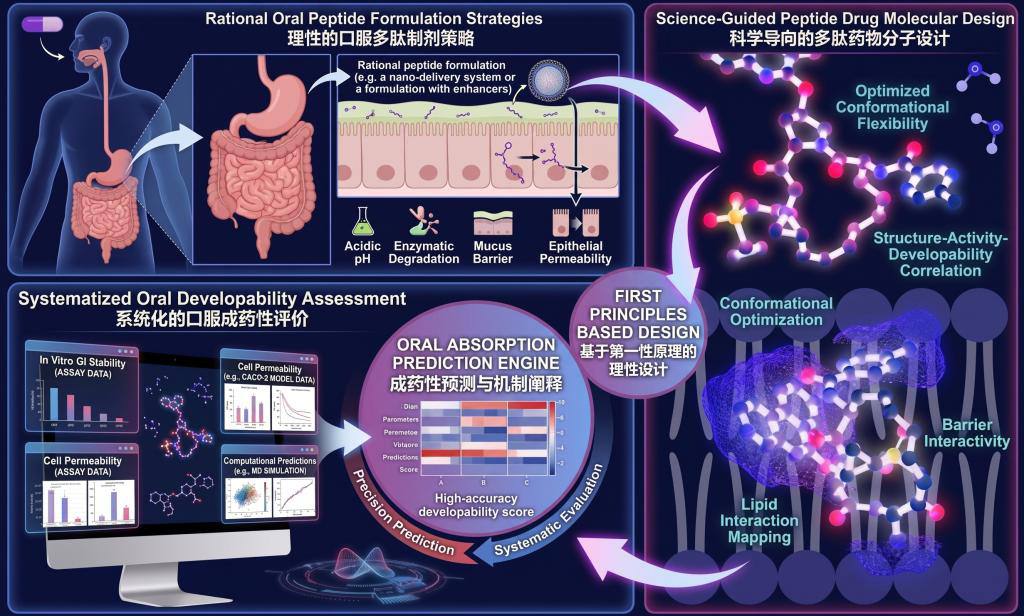
Specifically, we aim to focus on the following three mutually supportive, progressively advancing dimensions:
· Systematized Oral Developability Assessment: Establishing diverse in vitro oral absorption evaluation systems to enable precise prediction and mechanistic elucidation of oral peptide drug absorption;
· Rational Oral Peptide Formulation Strategies: Through in-depth investigation of the biological mechanisms underlying GI molecular absorption and transport, developing oral peptide delivery technologies grounded in physicochemical and cell biological mechanisms;
· Science-Guided Peptide Drug Molecular Design: In the future, we aspire to leverage profound understanding of peptide molecular physicochemical properties, structure–activity relationships, and interaction mechanisms with biological barriers to rationally design peptide drug candidates that simultaneously possess high biological activity and excellent oral developability, and to summarize the design principles for this class of molecules.
Our laboratory serves as the core team of the Beijing Key Laboratory of Intelligent Design and Delivery of Oral Drugs. We have established deep scientific research collaborations and drug development partnerships with multiple leading domestic and international pharmaceutical companies, jointly accelerating the translation of oral peptide drugs from fundamental research to industrial application.
多肽药物兼顾高生物活性与高选择性,已成为继小分子化学药物和抗体药物之后深具变革性的新一代药物类型,在代谢性疾病、自身免疫疾病、心血管疾病等领域展现出巨大的临床转化潜力与产业价值。口服多肽产品的开发具有深远的临床意义与社会价值:它有望替代传统的注射给药方式,显著提升患者用药依从性与生活质量,降低医疗系统的长期负担,并极大拓展多肽药物的市场可及性。然而多肽口服面临胃酸和胃肠道酶解、肠道上皮渗透性差、肝脏代谢等多重生物学屏障,该领域的科研和产业发展受到显著制约,目前全球范围内仅有极少数口服多肽药物成功上市。
本实验室突破当前多肽药物口服制剂研发中依赖"trial-and-error"的高成本、低效率的传统范式,致力于构建一套基于分子-材料相互作用的"第一性原理"(first principle)、深度融合胃肠道(GI)生物学与生理学系统认知的科学理论体系,努力从经验探索迈向理性设计。
具体而言,我们希望聚焦以下三个相互支撑、层层递进的维度:
· 系统化的口服成药性评价:建立多种体外口服吸收评估体系,实现对多肽药物口服吸收的精准预测与机制阐释;
· 理性的口服多肽制剂策略:通过深入探究GI分子吸收和转运的生物学机制,开发基于物理化学和细胞生物学机制的口服多肽递送技术;
· 科学导向的多肽药物分子设计:未来,我们希望基于对多肽分子理化性质、构效关系及与生物屏障相互作用机制的深入理解,理性设计兼具高生物活性与优异口服成药性的多肽候选分子,并总结这一类分子的设计原则。
本实验室是"口服药物智能设计与递送"北京市重点实验室的核心依托团队,已与多家国内外领先制药企业建立了深度科研合作与药物开发伙伴关系,共同推动口服多肽药物从基础研究向产业应用的加速转化。